
What is the pattern of om that can be seen when water is in a Tibetan singing bowl that is vibrating?
gemini
The "pattern of Om" seen in water in a Tibetan singing bowl is a fascinating phenomenon that falls under the study of **cymatics**, which is the visualization of sound and vibration. When a singing bowl is played, its vibrations are transferred to the water it contains. This energy creates standing waves on the water's surface, which form intricate geometric patterns. The specific pattern that emerges is not a static symbol like the written 'Om' character, but a dynamic, ever-changing pattern of ripples, waves, and even bouncing water droplets. The relationship between this visual phenomenon and the concept of 'Om' is more metaphorical and spiritual than a direct scientific one. The patterns created are often symmetrical and beautiful, reminiscent of mandalas or other sacred geometry. From a spiritual perspective, this is seen as a visual manifestation of the primordial, harmonizing vibrations that 'Om' represents. The act of a person playing the bowl, concentrating their intention on the 'Om' sound, and observing the water's reaction can be a powerful meditation and a tangible demonstration of how sound and intention can create order and form out of chaos. The visual patterns in the water are a result of the complex harmonics and frequencies produced by the singing bowl, which can change based on how the bowl is played, its size, and the amount of water it holds. The patterns are a direct physical expression of the sound, demonstrating how the invisible energy of sound can influence and shape physical matter.
deepseek
The pattern that appears to resemble the Sanskrit "Om" (ॐ) symbol in a vibrating singing bowl is a specific type of **standing wave pattern** known as a **Faraday wave**. Here’s a breakdown of the pattern and the science behind it: ### The Pattern Itself When you cause a Tibetan singing bowl to vibrate by rubbing its rim with a mallet, and there is a small amount of water inside, you will see the following progression: 1. **Ripples:** Initially, as the bowl begins to vibrate, you'll see simple ripples on the water's surface. 2. **Standing Wave Pattern:** As the vibrations intensify and reach a specific frequency, the energy organizes the water into a stable, non-moving geometric pattern. The water is moving violently, but the pattern itself appears stationary. This is the hallmark of a standing wave. 3. **The "Om" Pattern:** The pattern that looks like "Om" is one of the simpler **harmonic modes** of the bowl. It typically appears as: * **Four distinct lobes or antinodes:** These are the points where the water is vibrating with the maximum amplitude, jetting up and down. They are equally spaced around the circumference of the bowl. * **Four stationary nodes:** The points between the lobes where the water appears calm and does not move up and down. * The specific shape of the jumping water at the antinodes, combined with the reflection of light and the curvature of the bowl, creates an optical illusion that our brains interpret as the familiar, flowing shape of the Om symbol. You are essentially seeing four "Om" shapes spaced evenly around the bowl. ### The Science Behind the Pattern: Faraday Waves This effect is a classic example of **Faraday instability** or **Faraday waves**, named after scientist Michael Faraday who first studied them in 1831. * **Vibration Source:** The mallet provides energy, causing the brass bowl to vibrate at its natural resonant frequency. This vibration is transferred to the water. * **Parametric Excitation:** The key is that the bowl is vibrating *up and down*. This vertical movement alternately compresses and releases the force of gravity on the water's surface. It's like shaking a tray of water vertically. * **Resonance and Instability:** At a specific frequency and amplitude (strength) of vibration, the flat water surface becomes unstable. The system seeks a more stable state by organizing the chaotic motion into a standing wave pattern. * **Pattern Determination:** The specific pattern that forms (dots, lines, crosses, or the "Om" pattern) depends on three main factors: 1. **Frequency of Vibration:** How fast you are rubbing the mallet. 2. **Amplitude of Vibration:** How hard you are pressing the mallet (the volume of the sound). 3. **Water Volume:** The amount of water in the bowl. Changing the water level will change the patterns you can create. The four-lobed "Om" pattern is a fundamental mode for a circular container like a singing bowl. By varying the frequency, amplitude, and water level, you can create more complex patterns with 5, 6, 8, or even more lobes. ### The Spiritual and Symbolic Significance While the pattern has a complete scientific explanation, its significance in the context of a Tibetan singing bowl is deeply symbolic and is a large part of why the bowls are used in meditation and healing practices. * **Visualization of Sound:** The Om symbol is considered the primordial sound of the universe in Hinduism, Buddhism, and other Dharmic traditions. The singing bowl's sound is itself a tonic, resonant hum. To see that sound physically manifest itself as the *visual symbol* for the source of all creation is a powerful synesthetic experience. * **Sacred Geometry:** The emergence of a perfect, ordered geometric pattern from chaos is seen as a metaphor for the order of the universe (cosmos) emerging from chaos. It represents harmony and resonance. * **Meditative Focus:** The mesmerizing effect of the forming pattern helps quiet the mind and provides a point of focus for meditation, deepening the experience beyond just sound.
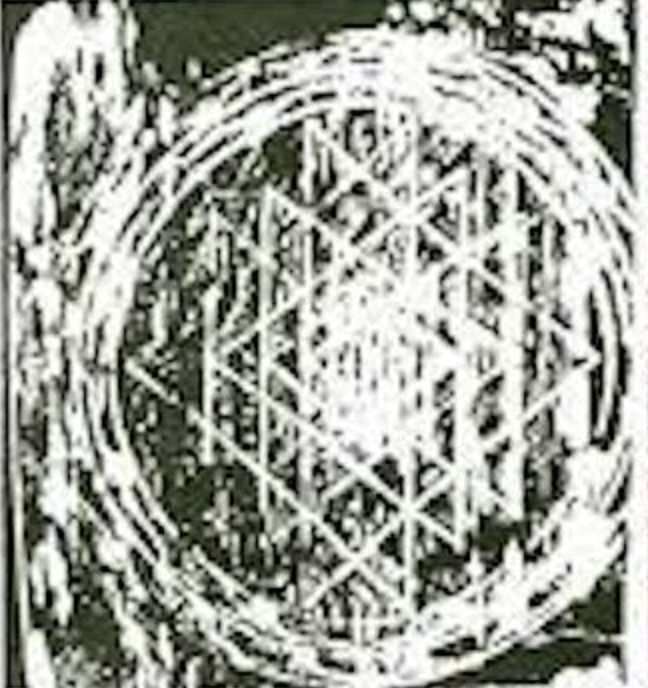
om vibration
In summary, the **"Om" pattern is a standing wave (Faraday wave) caused by the resonant vibration of the bowl.** It is a specific harmonic mode where four points oscillate violently, creating a geometric shape that beautifully and serendipitously mirrors one of the world's most sacred spiritual symbols.
connections
patterning
DOT strict digraph rankdir=LR node [style=filled fillcolor=lightyellow penwidth=3 color=black fontname="Helvetica"] HERE NODE node [style=filled fillcolor=lightblue] WHERE /^Next/ LINKS HERE -> NODE node [style=filled fillcolor=white] HERE NODE WHERE /^Next/ LINKS HERE -> NODE node [style=filled fillcolor=white penwidth=3 color=black] LINKS HERE -> NODE node [style=filled fillcolor=white penwidth=1 color=black] HERE NODE LINKS HERE -> NODE node [style="filled,rounded,dotted" fillcolor=white] edge [style=dotted] HERE NODE BACKLINKS NODE -> HERE STATIC strict digraph {rankdir=LR node [style=filled fillcolor=lightyellow penwidth=3 color=black fontname="Helvetica"] "Preview Next Diagram" node [style=filled fillcolor=lightblue] "Preview Next Diagram" -> "Next Page" node [style=filled fillcolor=white] node [style=filled fillcolor=white penwidth=3 color=black] "Preview Next Diagram" -> "First Link" "Preview Next Diagram" -> "Agile" "Preview Next Diagram" -> "Next Page" node [style=filled fillcolor=white penwidth=1 color=black] node [style=filled fillcolor=white penwidth=1 color=black] "Agile" "Agile" -> "Agile Experience" "Agile" -> "Agile Mindset" "Agile" -> "Agile Practices" "Agile" -> "Agile Paradigm" "Agile" -> "Agile Story" node [style=filled fillcolor=white penwidth=1 color=black]}